
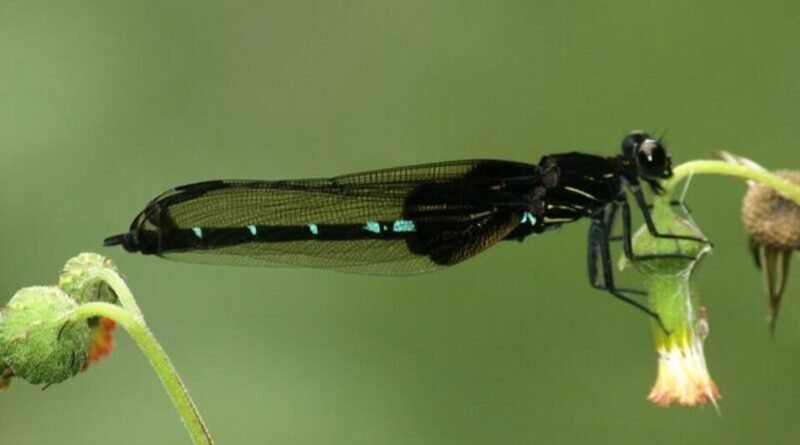
Dysphaea assamensis discovered in Karbi Anglong
Sushanta Roy,
Hills Live News,Diphu November 12: In a landmark discovery for biodiversity and regional taxonomy, researchers have officially described a brand-new species of damselfly named Dysphaea assamensis. The formal description of the species was published on October 13, 2026, in the international taxonomic journal Zootaxa.
The physical specimens that formed the basis of the formal description were collected during intensive field surveys conducted in May and June 2026 within the Karbi Anglong district of Assam.
Researchers discovered the new species during recent field surveys along a partially shaded lowland forest stream that flows from the foothills of the Karbi Anglong district through the Nambor and Garampani Wildlife Sanctuaries.
They netted five male individuals, collecting specimens for closer morphological examination while also documenting the ecosystem.
Intriguingly, while the physical male specimens enabled a formal description of the male anatomy, including unique genital ligula and caudal appendages, the female of the species was successfully described using high-quality field photographs taken by citizen scientists and enthusiasts.
The discovery also highlights the vital role that online biodiversity platforms and photography play in modern conservation and classical taxonomy.
The specific epithet, assamensis, is an adjective derived from the state of Assam, India, reflecting both the locality where the species was first captured and its probable wide distribution across the region.
The newly published study finally resolves a long-standing taxonomic puzzle that persisted for nearly a century. Since 1927, damselfly populations distributed across Northeast India and Bangladesh had been mistakenly identified as Dysphaea walli—a species native to Myanmar.
Comprehensive morphological and taxonomic investigations by the research team conclusively proved that the regional populations are entirely distinct, establishing Dysphaea assamensis as a unique species native to Northeast India and neighboring areas.
The discovery and formal description were led by a multi-institutional collaborative team of experts: Rima Amsih of Dibrugarh University, Arajush Payra and Dr. Vishwanath Karad MIT World Peace University, K. A. Subramanian of Zoological Survey of India and Samrat Sengupta Debraj Roy College (Autonomous), Assam.
“The formal description of Dysphaea assamensis not only adds a remarkable new species to India’s odonata fauna but also corrects a historical misidentification that has lasted since 1927, shedding light on the unique and under-documented biodiversity hotspots of Northeast India.” Research team highlights.