
14th Eastern Himalayan Naturenomics™️ Forum Day Two Explores Forest Conservation and Biodiversity at Cotton University.
Dalim Phukan.
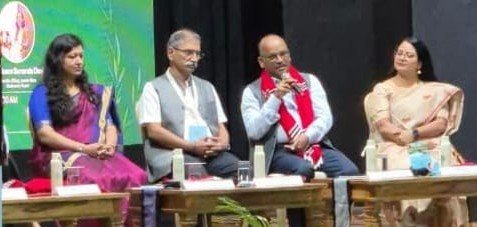
Hills Live News,Guwahati,October 31:The second day of the 14th Eastern Himalayan Naturenomics™️ Forum (EHNF) 2026 was held today at Cotton University, Guwahati, under the theme “Forests and Biodiversity.” Organised by Balipara Foundation under the overarching theme “Future of the Third Pole and the Himsagar,” the day brought together researchers, conservation practitioners, forest officials, academics, policymakers, students and other stakeholders to deliberate on the challenges and opportunities surrounding forest conservation and biodiversity across the Eastern Himalaya.
The day witnessed the participation of distinguished speakers and thought leaders, including Leena Nandan, former Secretary, Ministry of Environment, Forest and Climate Change (MoEFCC); S. Ramadorai, Chairman of Karmayogi Bharat; Prof. Toru Terao and Prof. Kazuya Ishii of Kagawa University, Japan; and Prof. Ramesh C. Deka, Vice-Chancellor of Cotton University, alongside several other experts and practitioners from the region and beyond.
The discussions focused on the ecological significance of the Eastern Himalayan landscape, the need to strengthen biodiversity conservation efforts, and the importance of connecting scientific research with community-led conservation practices. Participants examined the pressures facing forest ecosystems, the role of indigenous and local communities in protecting biodiversity, and the need for collaborative approaches to safeguard the region’s natural heritage.
Emphasising the importance of fostering a harmonious relationship between people and nature, Prof. Toru Terao of Kagawa University, Japan, said, “We are inspired by the Japanese concept of Satoyama – a word that reflects the relationship between nature and human beings. Sato means village, while Yama means mountain. It represents the relationship between people and nature, where human development and ecological well-being evolve together.”
The programme provided a platform for interdisciplinary exchange, bringing together perspectives from academia, conservation organisations and practitioners working across the region. Discussions also highlighted the importance of protecting habitats and wildlife corridors, strengthening conservation partnerships and recognising the interdependence between healthy ecosystems and resilient communities.
A key focus of the day was the need to move beyond conventional approaches to conservation and build stronger connections between ecological knowledge, policy and action on the ground. The conversations underscored that forests are not merely repositories of biodiversity but also sustain livelihoods, cultural identities, water systems and the ecological balance of the Eastern Himalaya.
The engagement of students and young participants further added to the discussions, encouraging the next generation to engage with questions of biodiversity protection, ecological restoration and sustainable landscape management.
The second day formed part of the Forum’s five-day, multi-university programme, which brings together institutions across Guwahati to address interconnected priorities of the Eastern Himalaya. The Forum will move to IIT Guwahati on 1 November for discussions on Water and Energy, followed by Sustainable Land Futures at Gauhati University on 2 November. The concluding day, on 3 November, will be hosted by Assam Royal Global University under the theme Green Technology, Innovation and Entrepreneurship.
Through EHNF 2026, Balipara Foundation continues to foster dialogue and partnerships across academia, government, civil society and industry, with the aim of advancing collaborative responses to the ecological and developmental challenges of the Eastern Himalaya.