
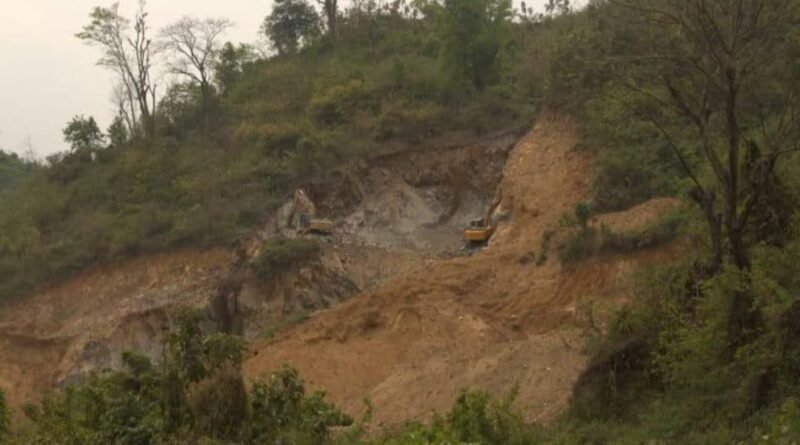
Forests fade as decades of pressure reshape karbi Anglong landscape
Hills Live News Desk
Sushanta Roy
Diphu April 26: The natural environment of Karbi Anglong and West Karbi Anglong has been steadily degrading since the 1970s, with recent data revealing the scale of damage to forests, land, and wildlife.
Recent satellite-based studies show that Karbi Anglong is among the worst-affected regions in Assam. Between 2001 and 2020, the district lost about 97.4 thousand hectares of tree cover, marking nearly a 12% decline in forest area.
Further research indicates that environmental change is continuing rapidly. Between 2013 and 2023 alone, forest cover in the district decreased by around 108.56 square kilometers, while agricultural land increased by 26.69 sq km and built-up areas expanded by over 30 sq km.
Experts link this shift to population growth and land-use changes. The population of Karbi Anglong has grown from about 9.5 lakh in 2011 to over 11 lakh (estimated 2025), increasing pressure on forests for settlement and farming.
Illegal activities have also played a role. Reports suggest long-standing timber smuggling and unregulated quarrying have caused large-scale forest loss.
In one recent case, over 80 lakh cubic meters of stone were reportedly extracted beyond permitted limits, raising serious environmental concerns.
Forest fragmentation studies reveal that dense forests have gradually turned into open and degraded forests over the past decades, largely due to encroachment and expanding human settlements.
The ecological impact is visible in wildlife as well. Habitat destruction has increased human-animal conflict across Assam, with over 1,400 human deaths and 1,200 elephant deaths recorded between 2000 and 2023, partly linked to shrinking forest areas.
Environmentalists warn that if current trends continue, the region may face long-term consequences such as soil erosion, water scarcity, and loss of biodiversity. Despite conservation efforts, balancing development with environmental protection remains a major challenge.
Local voices reflect growing concern. “Earlier, forests were dense and rivers flowed all year. Now, both are declining,” said a resident, highlighting the visible changes over generations.
The situation in Karbi Anglong and West Karbi Anglong stands as a clear example of how continuous human pressure since the 1970s has reshaped a once-rich natural landscape.